01
Entrepreneurial approach
I design the product, lead its development, and build the company that deploys it.
02
1982
Early work
At nine, I discovered computers. I created an application inspired by interactive adventure books, where readers choose their own path through the story.
At sixteen, I combined graphics, animation, sound and 3D to show what computers could now do.
At MBDC, an Apple reseller in Lille, France, my multimedia creations helped sell computers.
I proposed turning that work into a business activity.
MBDC opened a multimedia department and put me in charge.
There, I produced commissioned work for businesses: presenting a product, visualising a building before construction or explaining how an industrial installation works.
Alongside this, I experimented with moving images that users could interact with.
03
1991
Multimedia in public places
At seventeen, I founded and ran Totemak, one of France's first multimedia agencies.
We designed, produced and installed interactive experiences in public places.
Our clients included the French Ministry of Education, electricity company EDF and La Redoute.
In 1993, Totemak installed fifteen terminals at the Cannes International Film Festival, giving access to nearly two thousand films in five languages. The content was updated daily.
For SANEF's A16 motorway project in France, we turned a static map into an explorable territory. Residents could move from the overall route to their immediate surroundings, compare alternatives and understand the technical and environmental choices.
Across three consecutive editions of the Biarritz Communications Festival, our work won three awards.
04
1995
The interactive album
Apple wanted to show the music industry what CD Plus could make possible.
It chose me to design the prototype.
I proposed Prose Combat, an album by French artist MC Solaar, and secured his and PolyGram's agreement.
I designed and produced the experience: the same disc remained an album to listen to and became an interactive world when used on a computer.
On a computer, this world brought together synchronised lyrics, music videos and images.
I made the multisession disc before the standard had been finalised.
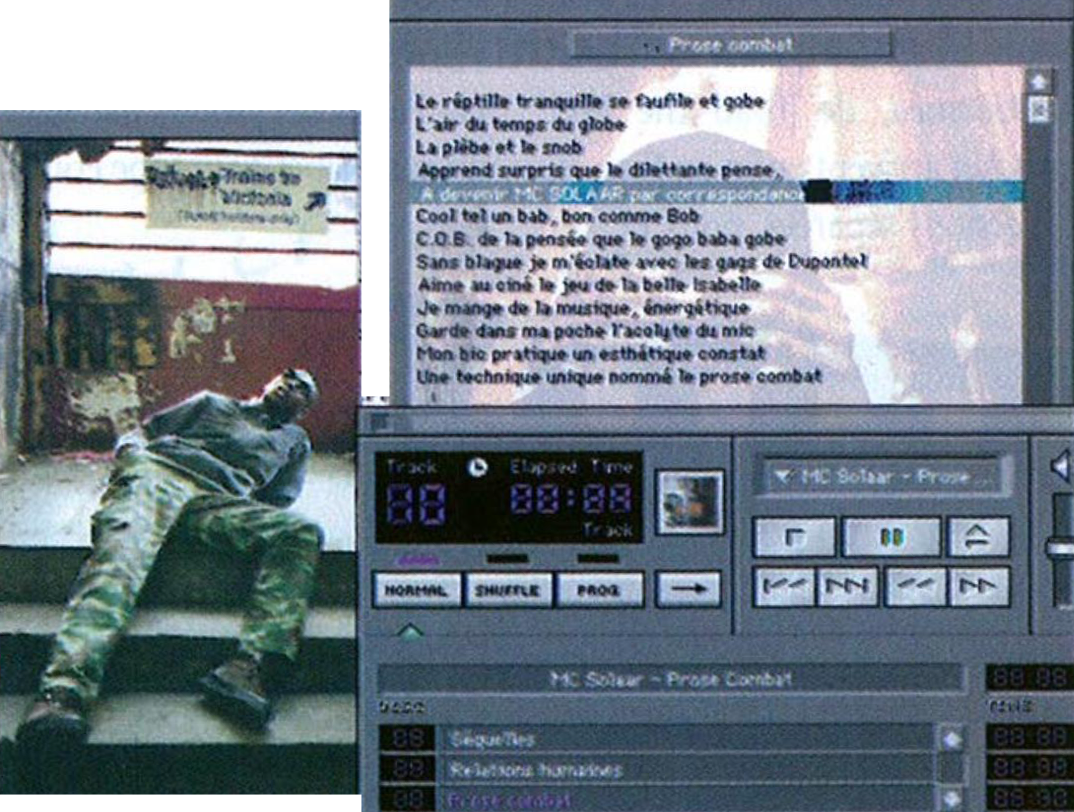
In 1995, the CD player offered, for the first time, track titles, synchronised lyrics and access to an interactive experience dedicated to the album.
Apple selected the prototype for its New Media World Tour.
I presented it at the opening of Apple Expo, on stage with MC Solaar and Michael Spindler, then Apple's CEO.
In 1996, Passer ma route, by Maxime Le Forestier, carried the same principle into a mass-produced CD Extra edition sold through retail channels.
05
1999
Music goes online
As 2000 approached, internet access was entering people's homes.
Universal Music invited competing bids to create its first website.
I won the contract on my own, against the web agencies of the time.
I chose Gédéon as the project's producer.
I designed the service from end to end and led its production.
Nearly a hundred people worked on the project over a year. The service went live in March 2000.
Twelve musical worlds gave access to 650 artists and 4,500 albums. Visitors could follow news about the artists, explore the catalogue by genre and period, and listen to excerpts.
Six months after launch, UniversalMusic.fr led music websites in France by audience size.
06
2000
Opendisc
MP3s, piracy and CD burners were disrupting the record industry.
The industry fought piracy.
I saw another possibility: offer more to those who bought the music.
I founded Opendisc.
It brought together what I had learned from CD Extra and the internet.
The disc became the key to an online service reserved for its buyer.
Opendisc software became part of the industrial process of manufacturing albums.
Record labels entrusted us with the master, the reference version of the album. We integrated Opendisc software into it under the industry's quality and security standards. The prepared master then went to the factory for disc production at scale.
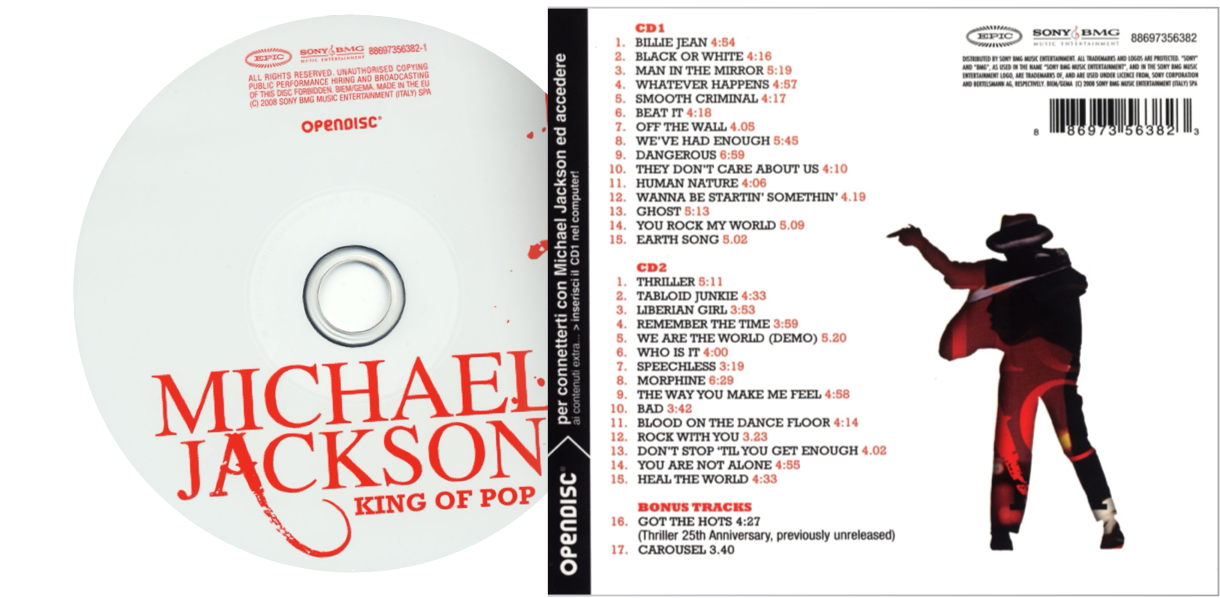
A 2-CD Opendisc compilation, released on 3 October 2008 by Epic (Sony BMG).
On a hi-fi or in a car CD player, the album played like any ordinary CD.
Inserted into a computer, the disc opened the artist's online space.
The buyer could choose whether to register.
Once the buyer had registered, the album no longer ended when it left the factory. The artist's online space evolved with new material: unreleased tracks, music videos shown ahead of release and behind-the-scenes features.
The artist and label could also email the buyer with news, invite them to a private concert or offer them the chance to take part in a music video shoot.
Artists and their labels could now get to know their audience and maintain a direct, continuing relationship with them.
We helped record labels develop the ongoing relationship between artists and their audiences.
We became one of the first data marketing companies in the music industry.
For the first time, record labels had qualified data about their consumers: sociodemographic profiles, geographical areas, behaviour and purchase journeys.
Over ten years, working with Opendisc's teams, I built the company and organised its international growth.
Opendisc featured on albums by Moby, Robbie Williams, Katy Perry and Michael Jackson, among others.
We worked for all four major record companies across Europe, North and South America, and Asia.
At its peak, Opendisc had six million users, and its brand appeared on more than 1,200 albums worldwide.
07
2014
Video you can explore
I turned to the last major medium still passive and linear: video.
You could play a video, pause it, fast-forward or rewind. But you could not search within its content or interact with what appeared on screen.
I co-founded Synchronized so that audiences could interact with what they were watching.
L’Œil de Links was Synchronized's first commercial project.
For L’Œil de Links, Canal+'s cultural television programme, I designed an application that made every segment navigable and brought all the episodes together in one environment.
Viewers entered the programme through a topic that interested them, then moved from a work to its creator, its techniques and its places. Across episodes, the archive could be explored by artist, trend or geography.
Users said they could “browse” the programme. They spent more than 26 minutes with it on average, longer than the programme itself lasted.
In 2015, the L’Œil de Links application turned Canal+'s cultural programme into a living network of works, artists and archives.
I took the principle further with The Hunt, a BBC wildlife series. Every animal appearing on screen became explorable.
Viewers could enter The Hunt through an episode or an animal. When a species appeared, the screen opened up its world: images, characteristics, habitat, prey and predators.
The application was sold internationally through the App Store and Google Play.
In 2016, this 30-second spot accompanied the launch of the application on the US channel BBC America.
08
2017
Studio and Quotidien
I designed Synchronized Studio, software for editing and producing these experiences at scale.
TF1, a French broadcasting group, selected Synchronized for its Media Lab at Station F, Paris's startup campus. The experiment was designed to increase the time viewers spent with Quotidien.
On MYTF1, the on-demand platform of the French broadcaster TF1, the 90 minutes of Quotidien—a current-affairs show hosted by Yann Barthès—became a non-linear experience. Each viewer chose which segments to watch and in what order.
Viewers built their own selection from the day's segments: a news story, a political interview, a comedy segment, or a report.
They could then generate cross-cutting playlists across the whole catalogue, for example around guests from film, sport, or live music. Each new programme added to the catalogue.
In 2018, this video accompanied the launch of Quotidien's interactive replay on MYTF1.
The challenge was to reproduce this experience every day and put it online as soon as the programme ended.
2018
From 2018, we developed our own artificial-intelligence system, which automatically divided, labelled, and linked every segment.
In 2018, Synchronized showed how its AI structured video content so viewers could assemble their own selection from the programme and follow a topic through the archive.
Average time spent per user was four times higher than for the programme in its conventional on-demand format.
In a qualitative study, users gave the experience a rating of 4.7 out of 5.
TF1 became a client and a partner in deploying the technology, then invested in Synchronized.
09
2020
AI across entire catalogues
Faced with streaming platforms, broadcasters needed to expand their catalogues and improve the experience they offered viewers.
At that scale, manual work could no longer keep up.
I led Synchronized's transformation into a SaaS platform that prepared media organisations' programmes before they went online.
Its AI suggested thumbnails, segment boundaries, advertising breaks, and the “Skip intro” and “Next episode” options.
It analysed the content and context of the videos.
Operational and editorial rules turned that analysis into suggestions.
Smart AD Breaks — preparing video advertising breaks with AI.
In Synchronized Studio, the teams validated each suggestion.
Broadcasters and studios used the platform to prepare videos for their on-demand services.
In March 2021, AWS selected Synchronized as one of fifteen partners worldwide for the launch of its Machine Learning Competency programme.
At Olympusat, a US television and media company, the platform processed 20,000 episodes and films in a few days.
A large share of the catalogue became monetisable.
Shawn Copenhaver, Olympusat's network operations manager, explains how Synchronized improves the placement of ad breaks and frees editors from that manual task.
In 2024, an industry jury awarded Synchronized the Best AI Innovation prize at the Broadcast Tech Awards.
10
2026
Today
I am now beginning a new entrepreneurial chapter.
I am designing a digital experience that uses AI to connect and organise vast collections of content and information into narratives people can explore.
The ambition is to improve access to knowledge, culture and information.
The project remains confidential.
I am speaking with investors and strategic partners who may support the project.